
Skip to content

+1 (612) 209-2350

WhatsApp
Exceptional Safaries 10+ Years Of Excellence
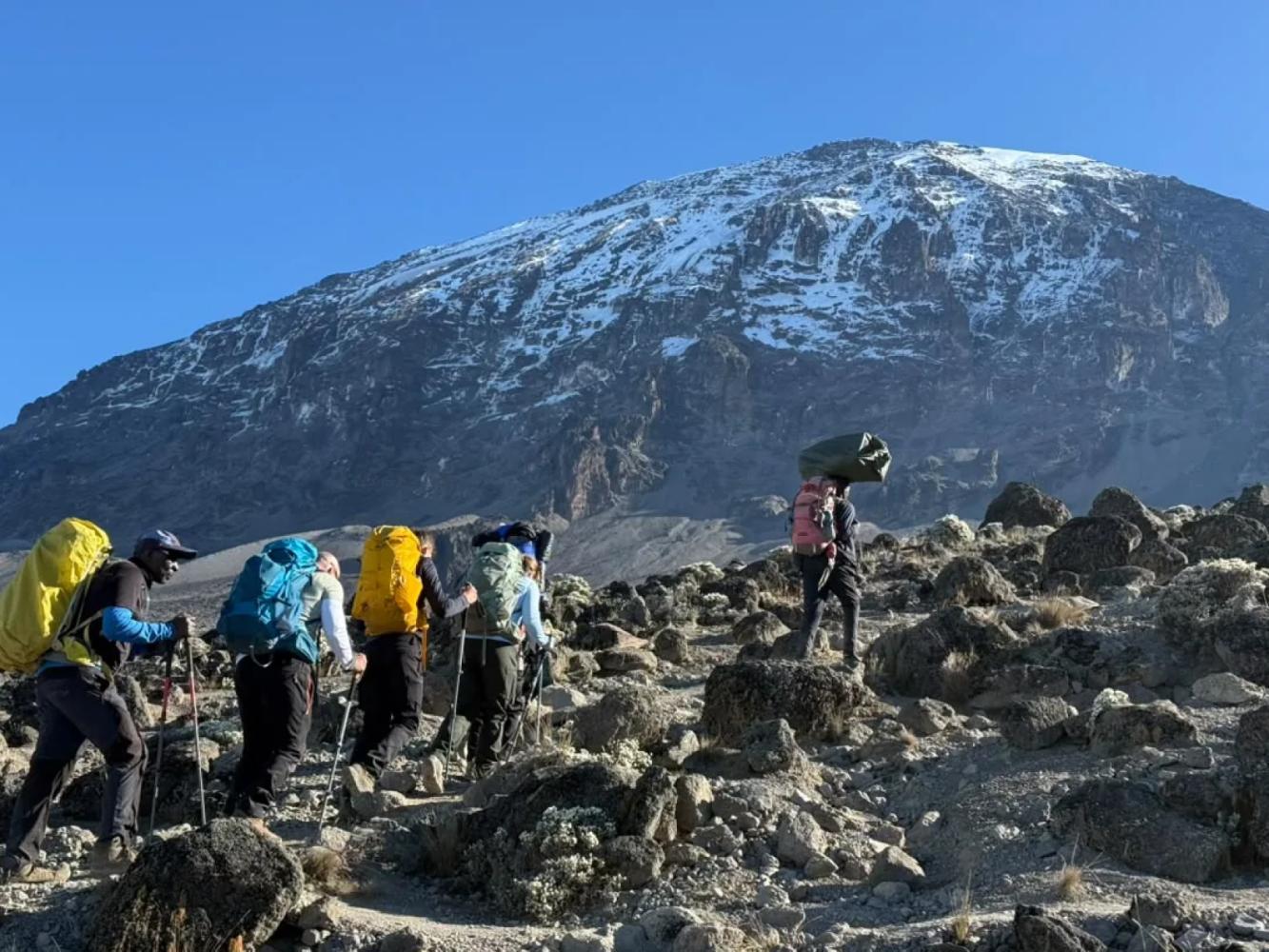
A line of climbers heading up the rocky trail towards Kibo

2026 – 2027 edition

Kilimanjaro Packing List

Every item you need, explained – from the rainforest gate to the roof of Africa. Layering, weight limits, summit-night kit, hire options and a printable checklist, from the mountain team that has guided climbers since 2011.

climate zones from rainforest to glacier
5
porter limit for your packed duffel
32 lb
water to drink every day on the trail
3–4 L
possible wind chill on summit night
-20°C

Packing for Tanzania’s great mountains

What you carry decides how comfortable – and how safe – you will be

Whether you are heading for Uhuru Peak on Kilimanjaro, the knife-edge crater rim of Mount Meru, the smoking summit of Ol Doinyo Lengai or the quiet slopes of Mount Hanang, this is the packing list we give every Exceptional Safaries climber. Each item is explained: what it is for, how many to bring, and whether it rides in your day pack or in the duffel your porter carries.

“Pole pole”

Swahili for “slowly, slowly” – the first thing every Kilimanjaro guide will tell you, and the best advice in this guide.

Prepared by the Exceptional Safaries mountain team, led by Roger Kaimukilwa, Operations Director, who has stood on Uhuru Peak more than 100 times.

The five golden rules

  1. 1

    Stay under 32 lb.

    Your porter’s load limit is 32 lb / 14.5 kg for your duffel, fully packed. Weigh it at home.

  2. 2

    Layers, not bulk.

    Several thin layers beat one thick coat – you add and remove them as the climate changes.

  3. 3

    No cotton.

    Cotton holds sweat and rain and chills you fast. Choose wool or synthetics.

  4. 4

    Keep it dry.

    Everything in the duffel goes inside dry bags. A wet sleeping bag at 4,600 m (15,092 ft) is dangerous.

  5. 5

    Break in your boots.

    New boots cause blisters. Wear them on at least two long hikes before the trip.

Understanding the climate

From rainforest to arctic summit

Climbing Kilimanjaro is like walking from the equator to the pole in a week. Temperatures fall roughly 6–7°C for every 1,000 m (3,281 ft) you climb, and the summit wind can make -15°C feel far colder. Every item on this list exists because of one of these zones.

The dry seasons (January to early March and June to October) are the most popular times to climb; in the rainy months, add extra dry bags and make sure your shell is fully waterproof.

  1. Arctic summit

    5,000–5,895 m (16,404–19,341 ft) · -20° to -7°C

    Full summit system

  2. Alpine desert

    4,000–5,000 m (13,123–16,404 ft) · -10° to 25°C

    Sun by day, down jacket by night

  3. Heath & moorland

    2,800–4,000 m (9,186–13,123 ft) · 0° to 20°C

    Fleece, wind shell, warm hat

  4. Montane rainforest

    1,800–2,800 m (5,906–9,186 ft) · 12° to 25°C

    Light layers + rain gear

  5. Cultivated foothills

    800–1,800 m (2,625–5,906 ft) · 20° to 30°C

    Shorts or light pants, sun hat

The layering system

Instead of one heavy coat, you wear thin layers that each do one job. Open zips and remove layers before you sweat; add a layer before you feel cold at rest stops. On summit night you will wear all four.

  1. 1

    Base layer

    Wicks sweat off your skin

    Thermal tops & bottoms, wicking shirts

  2. 2

    Mid layer

    Traps warm air

    Midweight fleece jacket, fleece pants

  3. 3

    Insulation

    Holds heat when you stop

    Heavy fleece + down or ski jacket

  4. 4

    Shell

    Blocks wind, rain & snow

    Waterproof jacket & shell pants

Why “no cotton”? Cotton absorbs water and takes hours to dry, pulling heat from your body. Jeans, cotton T-shirts and cotton socks are the most common cause of cold, miserable climbers. Choose merino wool, polyester, nylon or blends.

Before you pack

What goes where

You will split your belongings four ways before the climb begins. Your fully packed duffel must stay at or under 32 lb (14.5 kg) – the limit Kilimanjaro National Park sets for each porter.

Duffel bag

Carried by your porter between camps

  • Sleeping bag in compression sack
  • Spare clothing & thermal layers
  • Summit jacket, fleece pants, mittens
  • Camp shoes
  • Toiletries & towel
  • Spare snacks, batteries, power bank
  • Packed in dry bags; max 32 lb / 14.5 kg

Day pack

Carried by you every day

  • Water: 2–3 litres
  • Rain jacket & shell pants
  • Fleece, warm hat, light gloves
  • Sun hat, sunglasses, sunscreen, lip balm
  • Headlamp + spare batteries
  • Snacks, electrolytes, personal meds
  • Blister kit, hand sanitiser, wipes, toilet paper
  • Phone / camera, power bank

Arusha lodge storage

Locked, waiting for your return

  • Rolling suitcase
  • Safari & Zanzibar clothing
  • Souvenirs
  • Clean clothes for after the climb
  • Large camera if not taken up the mountain

With Roger

For safekeeping – you receive a receipt

  • Passport
  • Cash
  • Credit and ATM cards
  • Jewellery and watches
  • Other valuables
  • Keep a copy of your passport page with you

Flying on after the climb? Light-aircraft flights to safari camps and Zanzibar allow about 15 kg (33 lb) per person in soft-sided bags, including hand luggage. Hiring bulky items – sleeping bag, down jacket, poles – in Arusha keeps your travel load light.

The packing list

101 items, explained one by one

Tick each item as it goes in your bag – your ticks are saved on this device. The list is complete for Kilimanjaro; the section after it shows what to change for Mount Meru, Ol Doinyo Lengai and Mount Hanang.

Essential Recommended Optional Provided Day pack Can hire

Packing list · 01

Bags & Packing System

You will travel with two bags on the mountain. Your duffel is carried by a porter between camps and you will not see it during the day. Your day pack stays on your back and holds everything you need between breakfast and camp.

Guide’s tip Pack your duffel in this order: sleeping bag at the bottom, summit clothing in one dry bag, spare daily clothing in another, camp shoes and toiletries on top. Your tent routine becomes the same every night.

Packing list · 02

Footwear

Your feet carry you roughly 60–100 km (37–62 mi) on Kilimanjaro. Comfort and dry socks matter more than any other piece of gear.

Guide’s tip Change into dry socks and camp shoes as soon as you reach camp, and loosen your boot laces so they air out. On the descent, tighten laces over the instep so your toes do not hit the front of the boot.

Packing list · 03

Head, Face & Eyes

At the equator and at altitude the sun is fierce, while summit night can bring wind chill well below freezing. You need protection for both extremes.

Guide’s tip Wear your headlamp under your hood on summit night and keep the spare batteries in a chest pocket. If the lamp dims, swap batteries rather than shaking it – cold, not empty, is usually the problem.

Packing list · 04

Upper-Body Layers

Dress in layers you can add and remove as you climb through five climate zones. Wicking fabrics (merino, polyester, nylon blends) only – no cotton.

Guide’s tip Start each morning slightly cool. You warm up within ten minutes of walking, and stopping to remove layers breaks your rhythm and lets sweat build up.

Packing list · 05

Lower-Body Layers

Your legs need the same layering logic: light and breathable low down, windproof and warm at the top.

Guide’s tip Shell pants with full-length side zips can be pulled on over boots at a rest stop in seconds – worth the extra cost on summit night.

Packing list · 06

Hands

Cold hands end more summit attempts than tired legs. You need a light system and a seriously warm one.

Guide’s tip Put a hand warmer inside each mitten before you leave high camp, not when your fingers are already numb.

Packing list · 07

Sleeping

Good sleep is part of acclimatisation. Nights at high camp regularly drop well below freezing.

Guide’s tip Change into dry thermals before you get into your sleeping bag, never sleep in the clothes you hiked in, and eat a snack before bed – digestion helps keep you warm.

Packing list · 08

Water & Trail Food

Plan to drink 3–4 litres a day. Our crew boils and treats your water each day and provides all meals; the snacks below are your personal top-up.

Guide’s tip Track your intake by counting bottle refills. Two full 1-litre bottles before lunch, two more before dinner, plus tea and soup, keeps you on target.

Packing list · 09

Health, First Aid & Medication

Your guides carry a group first-aid kit and monitor your health daily. Your personal kit covers the small problems that otherwise grow – and any medication specific to you.

Guide’s tip Tell your guide about any medical condition and medication at the pre-climb briefing. Small issues – a hot spot on a heel, a mild headache – are easy to fix early.

Packing list · 10

Hygiene & Personal Care

There are no showers on the mountain – you will wash with a bowl of warm water at camp. Exceptional Safaries provides private mobile toilets at every camp.

Guide’s tip Wash hands with sanitiser before every meal, even when you do not feel like it. Most stomach troubles on the mountain are caught, not cooked.

Packing list · 11

Electronics & Extras

There is no electricity on the mountain. Cold drains batteries fast, so manage power carefully.

Guide’s tip At high camp, sleep with your phone, power bank and camera batteries inside your sleeping bag. Cold can drain a full battery overnight.

Packing list · 12

Documents & Money

Valuables stay off the mountain. Hand them to Roger for safekeeping during the climb – he will give you a receipt.

Guide’s tip Photograph your passport, visa, insurance policy and cards and save them to a secure cloud folder or email them to yourself before you travel.

Packing list · 13

For the Hotel & After the Climb

These items stay in your locked luggage at the Arusha lodge and come with you to safari and Zanzibar.

Guide’s tip Pack one clean outfit, sandals and a toiletry bag together in your Arusha suitcase so your first shower after the climb is effortless.

The big night

Summit night: what you wear and carry

The summit push is the coldest, darkest and longest day of the climb – often 12 hours or more on your feet, starting around midnight in temperatures from -7°C to -20°C with wind. Lay out this outfit before you sleep at high camp so you can dress in the dark.

Head
Warm hat · balaclava or buff over nose · headlamp on top of hat
Torso – 4 layers
Heavyweight thermal top → midweight fleece → heavy fleece → down or ski jacket (add the rain shell if it snows)
Legs – 3 layers
Heavyweight thermal bottoms → fleece pants → wind/waterproof shell pants (or insulated ski pants)
Hands
Liner gloves inside insulated mittens; spare warmers ready in a pocket
Feet
Toes taped · clean, dry heavyweight wool socks · gaiters
Inside pockets
Phone, spare lithium batteries, lip balm, hand warmers – kept against your body so the cold does not drain them

A typical summit night

  1. 22:30

    Wake-up, hot drink and a light snack in camp

  2. 23:30

    Depart high camp by headlamp, slow and steady

  3. 05:30

    Reach the crater rim (Stella or Gilman’s Point) near sunrise

  4. 06:30

    Uhuru Peak, 5,895 m (19,341 ft) – photos, then turn down

  5. 10:00

    Back at high camp: rest, eat, repack

  6. 15:00

    Descend to a lower camp for the night

Times are approximate and vary by route, weather and your pace. Your guide sets the schedule.

In your day pack

  • Two insulated water bottles, carried upside-down
  • Small bag of gels, gummies and chocolate
  • Spare warm layer (light down or fleece)
  • Sunglasses – for the glare at sunrise
  • Sunscreen and lip balm
  • Personal medication and blister tape
  • Toilet paper, sanitiser and a zip bag
  • Camera or phone in an inside pocket

Listen to your body – and your guide. Headache, nausea, dizziness, unusual breathlessness or confusion can be signs of altitude sickness. Tell your guide immediately; the cure is to descend. Your guide’s decision to turn around is always final.

Mountain by mountain

Adjusting the list for your climb

Mount Meru

4,566 m (14,980 ft)

A 3–4 day hut climb from Momella Gate through Arusha National Park, usually overnighting at Miriakamba Hut and Saddle Hut. An armed park ranger walks with you, and summit day runs along an exposed, narrow crater rim to Socialist Peak.

Pack

The full Kilimanjaro list for clothing, hands and head – the summit is cold and very windy. Trekking poles and gaiters are especially useful on the steep ash and scree. A sleeping bag rated around -5°C to -10°C.

You can leave

Expedition-grade insulated ski pants (fleece + shell pants is enough) and the pee bottle – huts have toilets nearby.

Climbing Mount Meru

Ol Doinyo Lengai

2,962 m (9,718 ft)

Tanzania’s active volcano, climbed through the night from the Lake Natron area to reach the crater rim at sunrise. The slope is relentlessly steep, with loose ash and rock, and Lake Natron is very hot by day.

Pack

Headlamp with fresh batteries, 3+ litres of water, gaiters, trekking poles, light gloves for scrambling, a buff or dust mask, a fleece and wind shell for the summit, and sun protection for the hot descent.

You can leave

Sleeping bag (for the climb), down jacket, mittens, thermal bottoms and ski pants. Never touch lava or step near active vents.

Climbing Ol Doinyo Lengai

Mount Hanang

3,420 m (11,220 ft)

An extinct volcano above the town of Katesh, in the heart of Datoga country, climbed as a long day hike or with one night camping, through farmland and forest to an open summit ridge.

Pack

Day pack with 3 litres of water, rain jacket, fleece, warm hat and light gloves, sun protection, poles, snacks and a headlamp. Overnight, add a sleeping bag rated around 0°C to -5°C, thermals and camp shoes.

You can leave

Summit expedition gear – down jacket, mittens and ski pants are not needed. Bring modest clothing for village visits.

Climbing Mount Hanang

Planning

Rent or bring?

Buying a full high-altitude kit can cost well over US$1,000. If this is a once-in-a-lifetime climb, hiring the bulky cold-weather items in Arusha is sensible. Tell us what you would like to hire when you book, so it is ready and fitted before your climb.

Item Hire?
Sleeping bagThe bulkiest item. Hiring saves luggage space for safari and Zanzibar. Yes
Down / ski jacketRarely needed again at home in warm climates. Yes
Insulated ski pantsOr fleece pants under your shell pants. Yes
Trekking polesSaves packing them in checked luggage. Yes
GaitersFitted at the gear check in Arusha. Yes
Mittens / summit glovesBring your own liners for hygiene and fit. Yes
Duffel bag & day packYour own day pack is more comfortable if you have trained with it. Yes
SunglassesCategory 3–4 mountain glasses. Yes
Hiking bootsWe strongly recommend your own, well broken-in boots. Possible
Socks, base layers, linersBring your own – for hygiene and comfort. No

Your preparation timeline

  1. 3 months

    • Book your climb and flights
    • Buy travel insurance covering trekking to 6,000 m (19,685 ft) and evacuation
    • Visit a travel clinic: vaccinations, antimalarials, altitude medication
    • Start training: long hikes with a loaded day pack, stairs, cardio
  2. 8 weeks

    • Buy or confirm boots and start breaking them in
    • List what you will hire in Arusha and tell us
    • Test your layers, day pack and headlamp on a long hike
  3. 4 weeks

    • Check passport validity and visa requirements
    • Collect prescriptions and fill your first-aid kit
    • Tell your bank your travel dates and countries
    • Get clean, recent US$ bills, including small notes for tips
  4. 1 week

    • Lay out every item and tick the checklist
    • Pack the duffel in dry bags and weigh it
    • Charge power banks; buy fresh lithium batteries
    • Clip your toenails
  5. In Arusha

    • Attend the pre-climb briefing and gear check with your guide
    • Collect hire gear and try it on
    • Hand valuables to Roger and get your receipt
    • Leave your suitcase in locked lodge storage

Good to know

Questions & pro tips

How cold does it get on Kilimanjaro?

Lower camps sit around 5–15°C at night. High camps on Kilimanjaro fall below freezing, and summit night ranges from about -7°C to -20°C with wind chill.

Who carries my bags?

Your porter carries your duffel (max 32 lb / 14.5 kg). You carry only your day pack, typically 5–8 kg.

Can I charge my phone on the mountain?

No – there are no power outlets. Bring at least two power banks, keep them warm in your sleeping bag and use airplane mode.

Is the drinking water safe?

Yes. Our crew collects, boils and treats water daily. You simply refill your bottles each morning and evening.

Do I need to bring food?

No. All meals are cooked by our mountain chef. Bring only personal snacks and summit-night gels or sweets.

What about toilets?

Exceptional Safaries provides private mobile toilets at camp. Carry a little toilet paper and a zip bag for the trail.

Can I wash my clothes?

Not really – things do not dry at altitude. Pack enough socks and underwear; lodges offer laundry after the climb.

Can I hire gear in Arusha?

Yes: sleeping bags, down jackets, ski pants, poles, gaiters, mittens, bags and sunglasses. Tell us what you would like when you book, so it is ready and fitted before your climb. Bring your own boots and base layers.

Do I need altitude medication?

Many climbers use acetazolamide (Diamox). It is a prescription medicine – discuss it with your doctor before you travel.

How should I tip?

Tips for guides, cooks and porters are given at a short ceremony at the end of the climb. We send recommended amounts with your trip documents.

EXCEPTIONAL

SAFARIES

2026 – 2027 edition

The complete

Mountain

Packing Guide

Free PDF · 24 pages

Get the Mountain Packing Guide

The whole list with every item explained, the summit-night outfit, Meru, Lengai and Hanang notes, the rent-or-bring table and a printable checklist. Leave your name and email and we will send it to your inbox.

We will also send you our newsletter with new journeys and offers. Unsubscribe at any time. Privacy Policy

Welcome back. You already have the guide – download it again below.

Questions about your kit?

Our mountain team has packed for thousands of climbers. If you are unsure about an item, want to hire gear in Arusha, or need advice for your route, get in touch – we would much rather answer a question now than have you cold on the mountain.

This guide is general advice. Weather, park regulations and entry requirements change; always check the latest information and follow your guide’s instructions on the mountain.